Teaching a child to ride in a single afternoon
Updated 6 September 2026
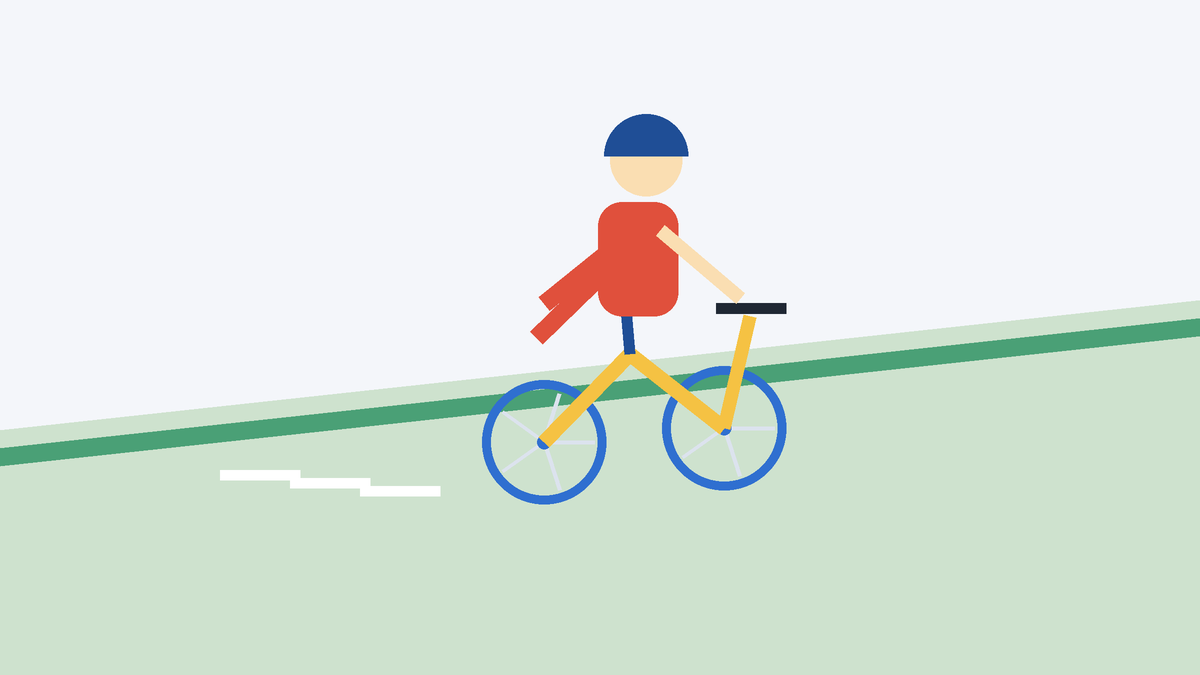
The traditional method — running behind holding the saddle — takes weeks and often ends in tears, because the child is not learning to balance at all. They are learning to rely on you, and the moment you let go, the thing they were relying on disappears without warning.
The gliding method removes the adult from the balance loop entirely. It usually works in one session.
Setting up
- Take both pedals off with a 15 mm spanner. The left pedal has a reverse thread, so it loosens clockwise. Keep them somewhere you will find them again.
- Drop the saddle until the child can sit and put both feet flat on the ground with knees slightly bent. This will look comically low. Leave it there.
- Find a very slight grassy slope — the kind you would barely notice walking. Grass matters: it is slower, softer and less intimidating than tarmac.
- Check the brakes work and that the child can reach the levers. If the bike has a coaster brake, explain that pedalling backwards stops it, though with the pedals off this will not apply yet.
The three stages
Stage one, walking. The child sits on the saddle and walks the bike along the flat, feet on the ground, steering wherever they like. Ten minutes. No instruction beyond letting them get used to steering while seated.
Stage two, gliding. At the top of the slight slope, they push off with both feet and let the bike roll, lifting their feet whenever they feel like it. At first this will be half a second. Over twenty minutes it becomes two seconds, then five. This is the entire skill, and it is happening without you touching the bike.
Stage three, steering while gliding. Set up something to ride around — a jumper on the grass works. Once they can glide for ten seconds and steer around an obstacle, they can ride a bike. Put the pedals back on.
The hardest instruction, which is for you
Do not hold the saddle, the handlebars or the child. Walk alongside if you like, but keep your hands off the bike.
Every moment you support the bike is a moment the child is not learning what it feels like to correct a wobble. The wobble is the lesson.
Putting the pedals back
Raise the saddle by two or three centimetres — enough that the leg extends properly when pedalling, but the child can still get the balls of both feet down. Show them where to set the pedal before starting: one crank at the two o'clock position, one foot on it, push down and away.
Most children who can glide for ten seconds ride away on the first or second attempt. If they cannot, take the pedals off and go back to gliding for another twenty minutes. It is not a setback, it is the same lesson with more repetitions.
Stopping comes before going
Before the first pedalled ride, spend five minutes on braking alone. Walking pace, squeeze both levers evenly, feet down. Then slightly faster. A child who can stop on purpose will try things; a child who cannot will freeze.
When to stop for the day
The moment it stops being fun, and not one attempt later. Two hours is a long session for a five-year-old, and a session that ends while they are still enjoying it means they will ask to do it again tomorrow. A session pushed fifteen minutes too far can cost a fortnight.