Balance bike or training wheels: what each one teaches
Updated 6 September 2026
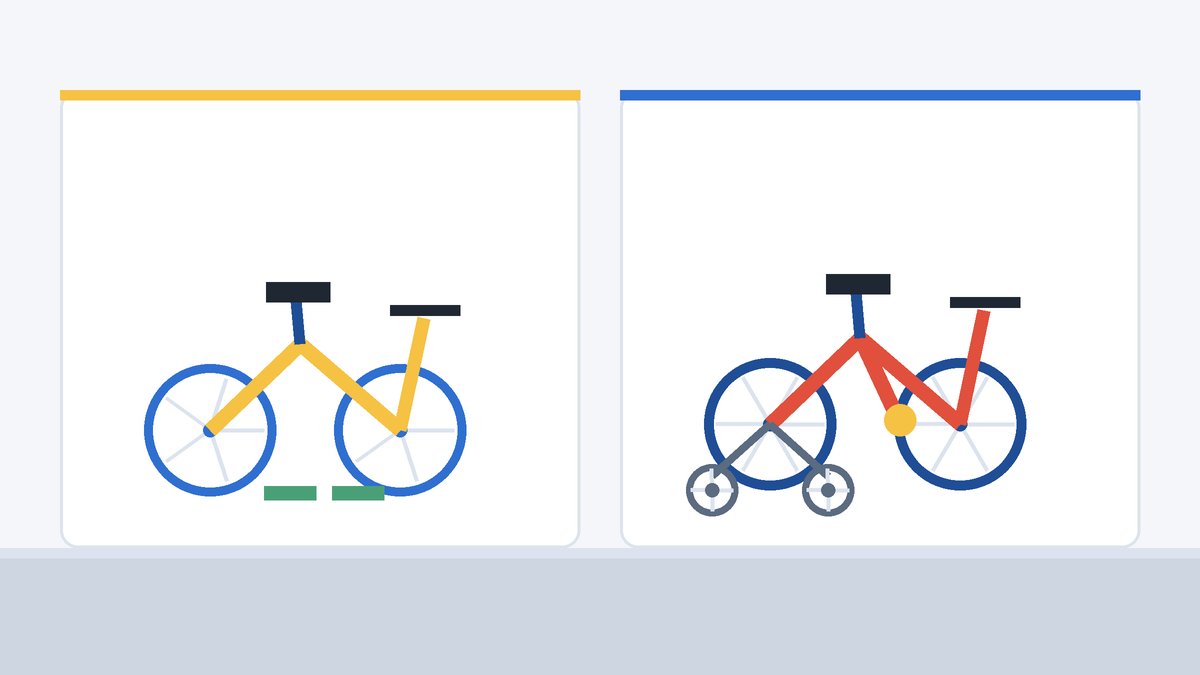
The question comes up the moment a child is tall enough for a bike, and it gets answered badly on both sides. Balance bikes are not automatically better, and training wheels are not useless. They teach different things, and the right choice depends mostly on how old the child is when you start.
What riding a bike actually requires
Three separate skills, learned in any order: balancing while moving, steering to correct that balance, and pedalling. The last one is the easiest and the one children usually already understand from scooters and ride-on toys.
Balancing and steering are not really separable. A moving bike stays upright because the rider steers slightly into whichever way it is falling, constantly and without thinking about it. That correction is the whole skill, and it cannot be practised while the bike is held upright by anything else.
What a balance bike teaches
A balance bike has no pedals and no drivetrain. The child sits, walks it along, and gradually starts lifting both feet for longer stretches. Because nothing is propping the bike up, they are learning the steering correction from the first day.
The transition to a pedal bike is then usually very short. Children who have spent a few months on a balance bike often ride away on their first attempt with pedals, because the only new thing is the pedalling.
The catch is age. Balance bikes work best from roughly two to four. Start at six and the child may find it babyish and refuse, which makes it the wrong tool no matter how well it works in principle.
What training wheels teach
Training wheels hold the bike upright, so the child learns pedalling, braking and steering-to-go-where-you-want without ever learning the balance correction. That is a real set of skills and it produces a child who can move confidently around a park.
The cost is that the balance step is only postponed. When the stabilisers come off, the child starts learning what a balance bike would have taught, but now on a heavier bike, at higher speed, and with the memory of being able to ride already. That gap is where the frustration usually happens.
A middle route that works
Take the pedals off an ordinary small bike with a spanner, drop the saddle so both feet sit flat, and use it as a balance bike for a few weeks. Then put the pedals back on.
It costs nothing, avoids buying a second bike, and skips the balance gap entirely. Most cranks come off with a 15 mm spanner.
Choosing between them
- Child under four: a balance bike, or a small pedal bike with the pedals removed.
- Child four to six: pedals off first, then straight to pedalling. Training wheels are rarely worth the detour at this age.
- Child six or older: skip both. Lower the saddle, take the pedals off for one or two sessions, then put them back. Most children of this age get it within an afternoon.
- Child with balance or coordination differences: training wheels can be genuinely useful, because they let the child build confidence and enjoy riding while the balance work happens on its own timeline.
The one thing that matters more than either
Saddle height. On a bike being used to learn balance, the child should be able to put both feet flat on the ground while seated, with a slight bend in the knee. Every guide argues about equipment; almost none mention that a saddle two centimetres too high is the most common reason a child refuses to try again.